
Making a TCG in 2026, a Retrospective
Greetings Heroes, to kick off our development blog here I figured we should start at the source of all this: How exactly did we get here, and how does one make a TCG in 2026?
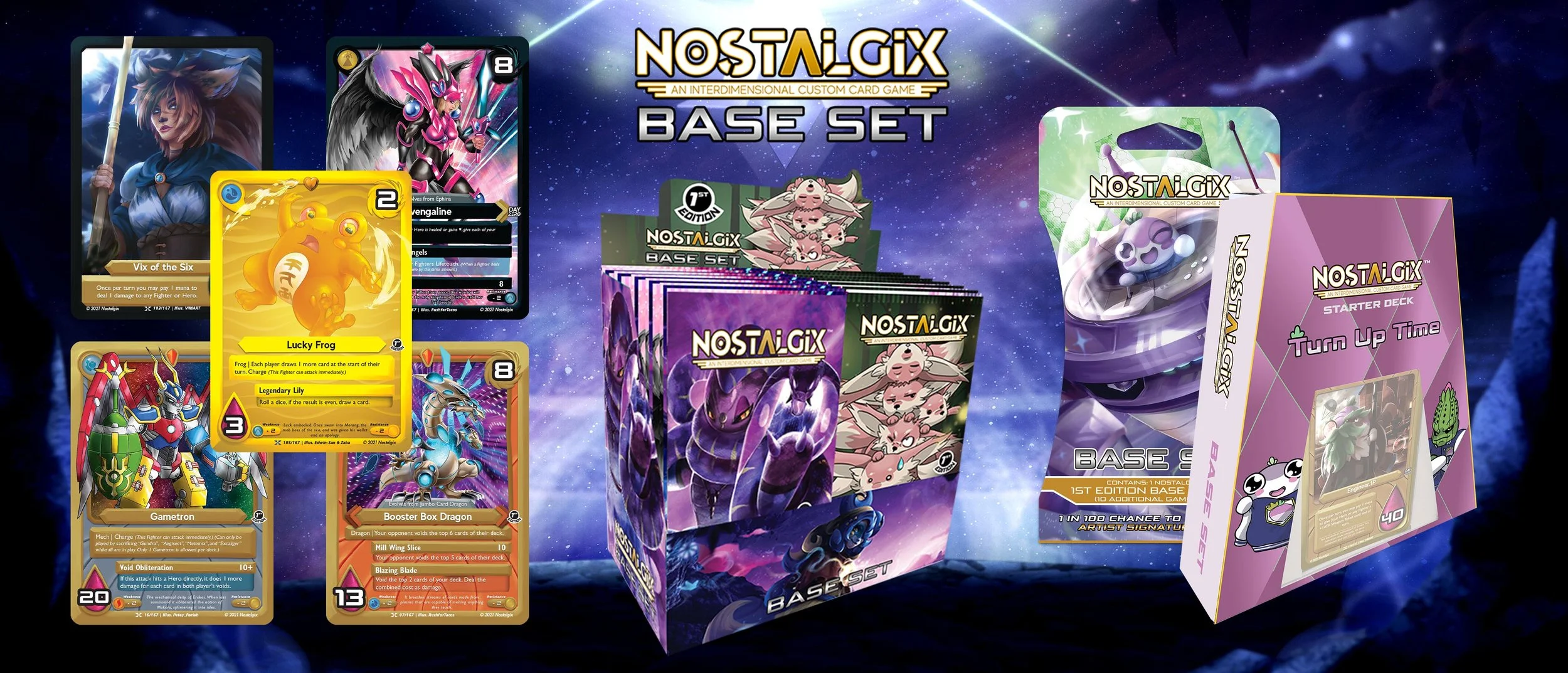
Nostalgix TCG Base Set
We’ll quickly breeze through the BIG ones. When you think of TCG there’s likely a handful of brands that come to mind. Pokémon, Magic the Gathering and Yu-Gi-Oh!. Later new titans were born. Games like One Piece, and Disney Lorcana joined the fray and have created a foothold. We won’t dive deep into these in this article, but suffice to say each has an existing well of characters to draw from and/or a vast legacy that is continued to this day.
It is from these initial titans and the retired games of old that an indie TCG scene began to brew starting far before, but most prominently visible during the Kickstarter boom of the early 2020s.
An Indie Game Renaissance
MetaZoo launched on Kickstarter in August of 2020 to a humble $18,249 spread across 255 backers. This is believed to be the start of the indie TCG renaissance. If you search Kickstarter for “TCG” there are 900 projects at present. Descending from newest to oldest, MetaZoo is #229. This game looked to capture Pokémon’s OG style, but for cryptids. A brilliant solve to the problem that plagues all TCGs at one point or another. How do you create characters people resonate with? MetaZoo’s answer, inherit them from centuries of legends. The same way Disney embodied fables, MetaZoo sought to embody legends. It’s a bold strategy and with smooth business partnerships (and a clutch sale amidst a bankruptcy) founder Michael Waddell was able to pass this promising company onto a consortium of TCG industry experts to continue the game into the future with a well of money and bandwidth he was no longer able to produce.
As MetaZoo’s Kickstarter quietly launched, other games were in the making. Games like Akora, D-Spirits, Otherworld, Polywog, and Arcana Resurgence soon launched after. Akora and D-Spirits in particular launched to over $250,000 each, breaking a barrier yet untouched in the space. And that’s where Nostalgix came in. At the tail end of 2021 I had completed a long ramp up from earlier in 2021 and launched Nostalgix on Kickstarter. The same week, a game called Grand Archive also launched! Both these games managed to sell over $900,000 on Kickstarter, simultaneously breaking the backer count and financial records within this category.
But that’s not where this story ends, it is where it begins. Four games in one year had just launched with over $250,000 in support. Coupled with a surge in demand for Pokémon TCG collecting powered by Logan Paul’s 1st Edition Base Set Booster Box opening in 2020 and only further accelerated by his purchase of Illustrator Pikachu for $1.275 million in July 2021, the TCG market’s eyes turned into dollar signs.
2022 brought games like Titan, Maelstrom, BlightBreed, Sorcery (new record), Kryptik, Otherverse, CannaBeast, Runeslingers, Alpha Clash, Mythik, Primal, Life, Elestrals, and more to the fray.
Few games since have captured the same highs since, and the frequency of TCG games on Kickstarter has wound down since this renaissance. Many of the above games launched new sets and sequels on the platform following this period. A few new games that did rise above however, soared. Games like Altered, Echoes of Astra and Wondrlnd hit the mark. Eventually even the big fish were lured in by the appeal. Cyberpunk for instance, launched in April of 2026 to $28,353,088 across 50,773 backers showing that indeed the category is still alive to this day.
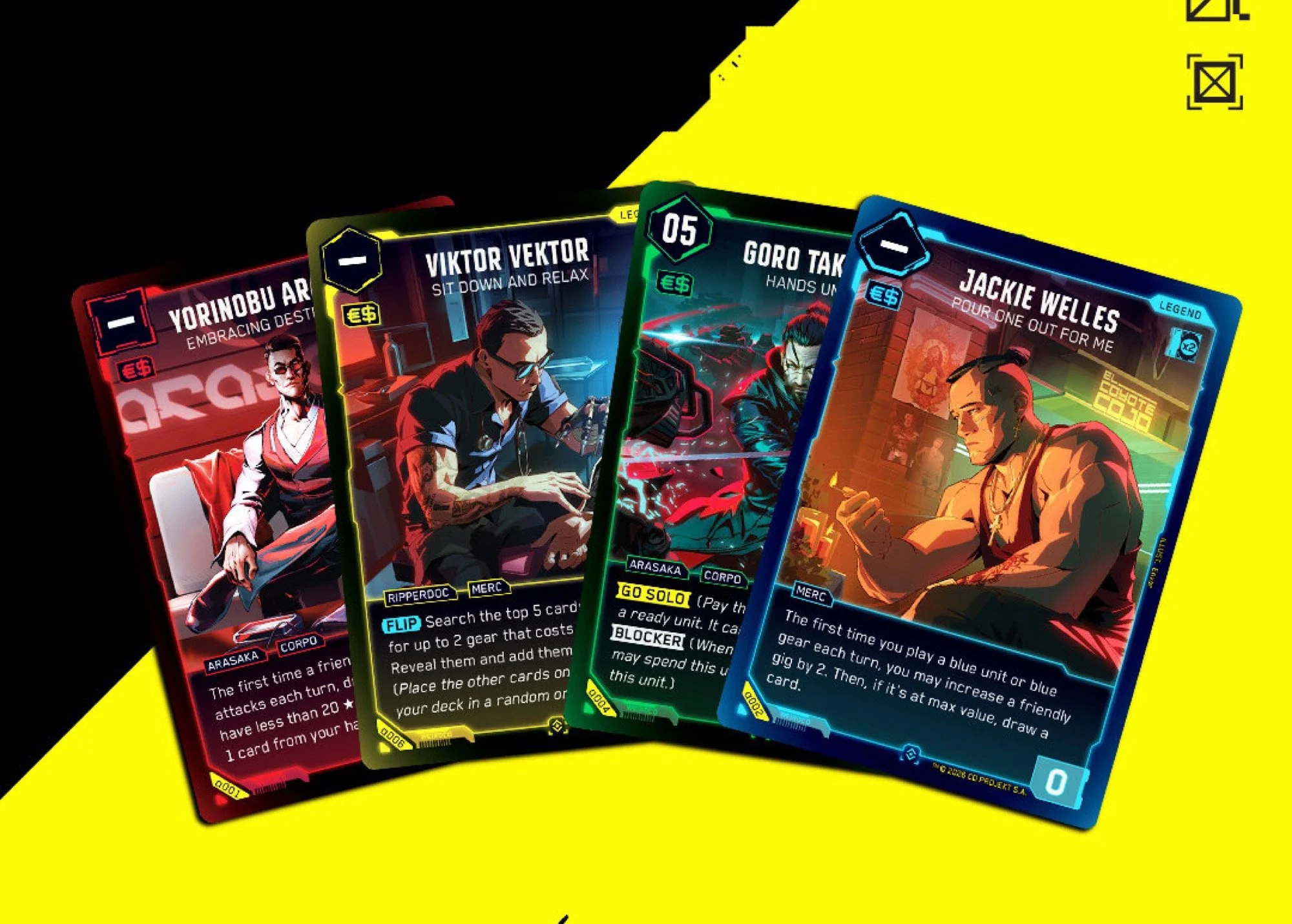
Cyberpunk TCG cards http://cyberpunktcg.com/
So from roughly 3 games of note in 2019 to 30 inside this article alone, and we haven’t touched on Weiß Schwarz, Digimon’s latest TCG, Flesh and Blood (the reigning indie champ), DragonBall Super, Cardfight!! Vanguard, UniVersus, or any of the other myriad of retired games with niche communities worldwide. Looking at you Xena the Warrior Princess TCG.
Suffice to say there are options to get your card game fix.
Digital TCGs
Paper too primitive for you? Are you too busy to attend an event? Good news! You can get your dopamine fix on literally any device including a smart fridge!
Digital card games filled not just the void that [early 2020’s world events] caused, but also the complexities of balancing a paper based game. They allowed timed exclusives, cosmetics and battle passes to be implemented unlocking entirely new ways to engage with players (and make money).
Games like Hearthstone, Gwent, Legends of Runeterra, and even Marvel Snap continue to pioneer new ways to enjoy card games. One could even argue games like Slay the Spire and Balatro have continued this tradition break to see how far the rabbit hole goes.
Do the big 3 have digital TCGs? Of course they do. Pokémon, Magic and Yu-Gi-Oh! each feature rich online versions of the game that remain accurate to what made their physical games popular.
Suffice to say, if you have the budget to go digital, it more often than not seems to pay for itself and then some. Oh? You’re completely broke? Just build it on Tabletop Simulator and let the community figure it out.
So Where’s that leave Us?
So we’ve got a dozen good digital card games, about 50 physical games, maybe 30 of which have communities at all, and then Fortnite and streaming services pulling everyone’s attention away from physical media. It’s a lot. How the heck do you compete with Fortnite!?
Money, partnerships, memory-making, FOMO, (and to a lesser degree) completionists.
Money
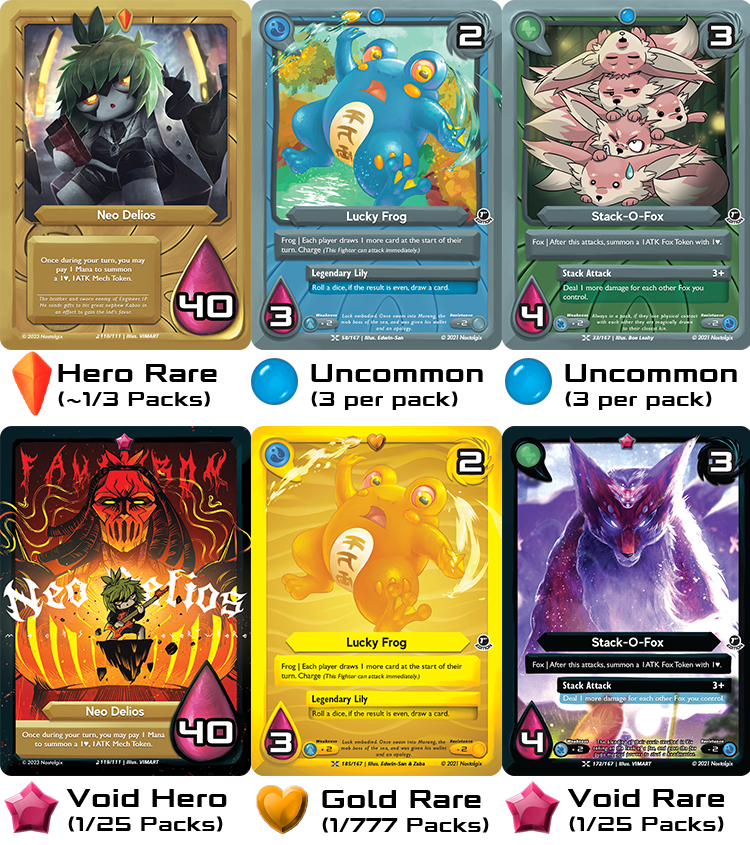
Nostalgix Harmonic Surge Rarities
We’re not talking $1000 here, or even $10,000. We’re talking north of $100,000 up past a million dollars here. To create a full set for a physical card game- let’s assume 150 cards in this set and you’re making 1000 booster boxes, this will cost you north of $90,000 based on average art costs and booster box prices (that I’m intentionally leaving ambiguous). Art costs will almost always remain where they are, booster box costs do go down. The big breaks happen at large milestones, think 1000, 2500, 5000, 10000. At some point the machine making them reaches an efficiency and your costs can drop significantly but consider- you’re still now buying 10,000 booster boxes. There is an inherent cost to produce and it only ever goes up.
Luckily, if you price those 1000 booster boxes at $90 each, you now have $90,000- wait… no no no. That’s right, you have nothing. You lose. Good-day sir.
Making TCGs is expensive. You need to be able to sell AT LEAST 2,500 booster boxes in a print run, or charge beyond what major developers above are charging to stay above water, and you’re not Pikachu. You’re not even Kuribo.
Partnerships

Unsplash Image of a player playing a card game
Partnerships are therefore make or break. If you yourself cannot get to 2,500 booster boxes, perhaps a distributor or partner with some skin in the game can help you get there. Well- kind of.
In the indie renaissance, many distributors across the world were also swept up in the money-eyed flurry. Conditioned by decades of TCG success they mostly opened the doors and their pocketbooks to make sure they stocked the next big hit. But it soon dawned on most that when an indie game and Charizard are sitting on a shelf next to each other, you’re gonna have 35/36 packs left of that indie game and a waitlist for Charizard.
So then what about the stores themselves? Yes! Now we’re getting somewhere. You just need to call 20,000 stores and convince 200 of them to support your game and order a case and your event kit, then host a demo event in-store, then keep doing that until a community forms, then stay educated on your game’s latest releases and keep doing so or at least decay slower than you can add new stores.
The reality is that this approach no longer works. Cold calling stores doesn’t convince Tom at the front desk to take a chance on you when they have Friday Night Magic coming up and 35 players are going to show to buy the latest set. So if you can’t cold call them, how do you convince them?
In-person store visits and events are the lifeblood of indie games, looking at you Ward. Does it limit your scalability, at first ABSOLUTELY, but it works. You’re going to have to develop iron-clad relationships with volunteer enthusiasts in your community and then as an organized force host how to play events at local game stores and get on their calendar. You’re going to have to convince over-worked, under-paid owners that there is demand for your work and you’re going to need to funnel sales through them to show on paper why they should care.
In addition to getting stores to care, you also need to continue building your partnerships with artists, production vendors, shipping and logistics companies, warehouse owners, fulfillment partners, the local post office (trust me, do it), convention leaders, vending suppliers, multi-chain stores, and event management software developers. You should probably also find an influencer or two cause it’s time for…
Memory Making
What’s the point at which a property goes from a blip in time to a legacy? I’d argue it’s right around when it goes multi-generational. Make it to 20 years and suddenly the customers you first had are now selling your game to their children, it’s a part of the family. This only happens if your game is worth remembering. Make sure to include as much excitement and potential for surprise and delight as possible because again, they could be playing Fortnite or watching [insert hit show] right now.
But despite what Fortnite has in terms of pure dopamine release, your card game can create even deeper memories because you are physically holding the items making them. Brains record memories better when more senses are activated, card games will always have a leg up in that regard. There’s no update patches to wait for before you open your binder and when EA eventually goes bankrupt in 2053 after the NFL ends, people will still be in possession of a binder with your cards in it. The ownership and tangibility is what makes your game immortal. Now use that factoid to pour your heart and soul into the quality and appeal of this because it quite possibly is all that will be left.
We’re talking holographics, exciting opening experiences, surprising gameplay, deep thinking, signatures, hidden secrets to keep people coming back, and delightful drops when they least expect it. Make it memorable for the right reasons.
FOMO
Another avenue to take would be FOMO, where were you when Charizard took flight and suddenly PSA 4’s were worth what a PSA 10 was in 2015. You missed out, and it’s never coming back. That’s the fear of missing out. Offer exclusives, but don’t allow them to spoil the game or make it unfair for the ever-attentive. There should be a cosmetic or completionist reward for paying attention. Things are only worth what someone is willing to pay for them, so make items worth paying for, worth collecting and worth learning about. Scarcity and proper balancing of higher rarity cards within a set also organically increases a bit of FOMO, incentivizing collectors to get the best cards before the set runs out of stock.
Completionists
We’ve all been there, you’re playing a platformer game and there’s one more collectible before you 100% the game. Stars, Heart Pieces, Bananas, records, you name it. There’s a player in TCGs that isn’t a player after all, they just want to complete your set. To dominate the challenge you’ve given them. Make that a goal worth chasing.
Offer a reward if they complete it, have top cards be incredibly rare, but attainable. Offer promotional cards at events but offer them at a number that makes collecting them achievable. This collector will rarely talk to you, but will absolutely adore everything you put out and scoop up burnt out player’s collections to add to their veritable treasure trove at home. Treat them right and you quite likely can turn them into both a true player and a generational collector.
Closing
We covered a lot, and somehow not even close to everything at the same time. Suffice to say, there is a lot that goes into making a successful TCG in 2026. Anyone who even attempts to do so is both insane and has my respect. It’s certainly possible, but not for the faint of heart.
Nostalgix and through it, myself have lived through this chaotically fun time and we’ve got the scars to prove it. This blog series then is going to unpack what was learned while building toward what comes next for us.
Stay tuned, our next blog is on art development… or is it on character creation. It’s certainly one not to be missed.
A Nostalgix card floating in a portal.